Inside Balaka’s never ending water woes
By Precious Msosa
It’s another day-break in Balaka; I stretch my hand from the bed to reach for my cellphone on the dressing table besides me. As usual, I quickly go through some WhatsApp messages, with the hope of bumping into some important ones in one of the groups I belong to.
My eyes quickly land on a Balaka Water Forum, a grouping of residents and some Southern Region Water Board (SRWB) district officials. By looking at the composition of the grouping, obviously one would expect that it is a grouping where officials alert residents of any water supply developments and vice versa. But alas! It is a one-way traffic.
So, on this particular morning just like on several others, most messages are from the residents, mostly wailing about the continued dry taps they are experiencing in their respective areas.
Boom! A touching one reads: “Kodi ku Balaka kuno ndikokanika madzi a m’mipopi mpaka kale kale basi? Ndiye a SRWB atikumbire zitsimetu.” (Has piped water proven an everlasting problem? Then SRWB better drill us some wells if this is the case). From this message, a flurry of replies from members follows, with many also echoing the plight.
Fishing out another outcry on the group, one member wrote: “As an institution mandated to provide clean and safe water, you were supposed to provide a lasting solution to these challenges that have for long deprived us this precious commodity. It doesn’t make sense for most areas to stay without water and with you providing no alternative source.”
Such is the nature of the discussions that punctuates this group week in week out.
False hopes
Early November 2025, the SRWB Balaka office made what it called a major breakthrough in what had been the perennial water shortages in the district. The office disclosed that its officers had discovered a big trunk in the main water supply pipe which was making it impossible for people to adequately receive water as it could hardly pass through.
Consequently, the office issued a notice of a two-day water supply shutdown to allow its engineers work on the deadlock. Soon after the elapse of the ultimatum, pictures and a video clip of the engineers removing the trunk that had blocked the mainline was shared on the group. In the video clip, one of the engineers is overheard saying “chonchi madzi akanatuluka bwanji?” (How could the water come out with this blockage?).
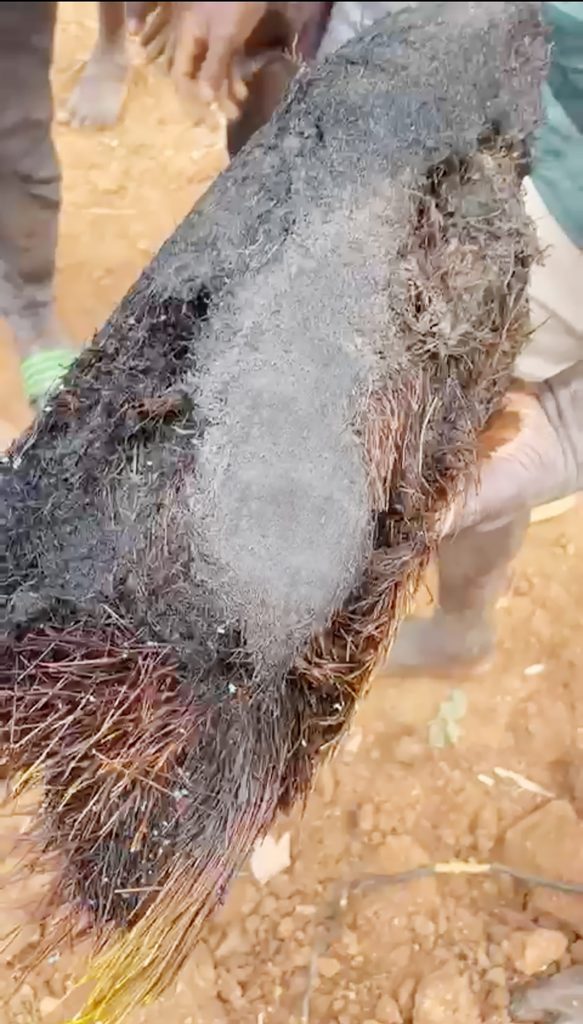
Scapegoat: A trunk that was found in the main pipe line in Balaka (Photo Credit: SRWB)
Expectedly, many people rejoiced on the group and hailed the office for a good job of ‘exorcising’ the demon to their water blessing. Upon seeing the trunk, many people were convinced that they could really not have water with the impact it had left. Finally, they had thought this was the beginning of a new chapter and that their cries of water shortages would be bygones. But behold, this has never been the case as most areas continue longing for the clean water from the board.
Actually, people are at pains to understand where the board is failing them. They feel they have been lied to for a long time. All they need to hear is an honest answer from the board as to why Balaka citizens continue to sing the same song all seasons. The dishonesty from SRWB is wanting.
It has repeatedly been said that water is life and realizing this, it is the more reason why the United Nations included it in the Sustainable Development Goals (SDGs) to be attained by 2030. For instance, SDG Goal No 6 talks about Clean Water and Sanitation; while Goal No 14 is about Life Below Water. Equally, there are other goals, which are also indirectly linked to water, emphasizing the importance of clean water.
To cement the importance of this commodity, the 39th African Union summit held in Addis Ababa from 11-15 February, 2026 attended by heads of state and officials from 55 AU member states centered on the theme: “Assuring Sustainable Water Availability and Safe Sanitation Systems to Achieve the Goals of Agenda 2063.”
This theme stresses that achieving sustainable water availability and safe sanitation systems is not just an environmental issue but a pathway to achieving broader socio-economic goals. However, if the current water situation in Balaka and perhaps many others, is anything to go by, then this remains a far-fetched dream for Malawi.
Mpira Water Trust hullabaloo
As one way of sustaining water supply in the district, the SRWB went into an agreement with Mpira Water Trust to be supplying it with extra water. Actually, at some point the Trust had threaten to cut off its supply due to the K60 million debt which the board was failing to settle. This made others think that the current water scarcity in the district is because the Trust had cut off its supply. However, according to Vincent Kafakoma, who is Mpira Water Trust district supervisor, they are still supplying the board with water because the payment issues were sorted out.
SRWB Zone Manager for Liwonde, Nzeru Banda also disclosed that they are currently paying the Trust K5 million weekly to offset the debt and it is not true that the water problem has been exacerbated because the Trust stopped supplying water due to the debt. He disclosed that they will finish paying off the debt in two months.
Current Status
According to some residents, since the board’s promise last year that things would get better from the time they had removed the trunk in the main line, the situation on the ground remains patchy.
Noel Banda from Vito area near Majiga 2 said things have not really improved as they can still stay without water for a maximum of two weeks. He said he has been to Balaka office for countless times but he is not getting satisfactory responses.
Banda said at the peak of the water problems last year, he just thought of drilling a borehole which he also said its water is very salty and not good enough for human consumption. As a result, when the water shortage hits, he buys the precious commodity from some stores which is very costly.
“I am tired of visiting their offices. I have just accepted that this is the life I have to live because each time I inquire from them, I don’t get convincing answers. With these persistent water shortages, I spend almost K60,000 monthly to buy drinking water and this is very costly,” lamented Banda.
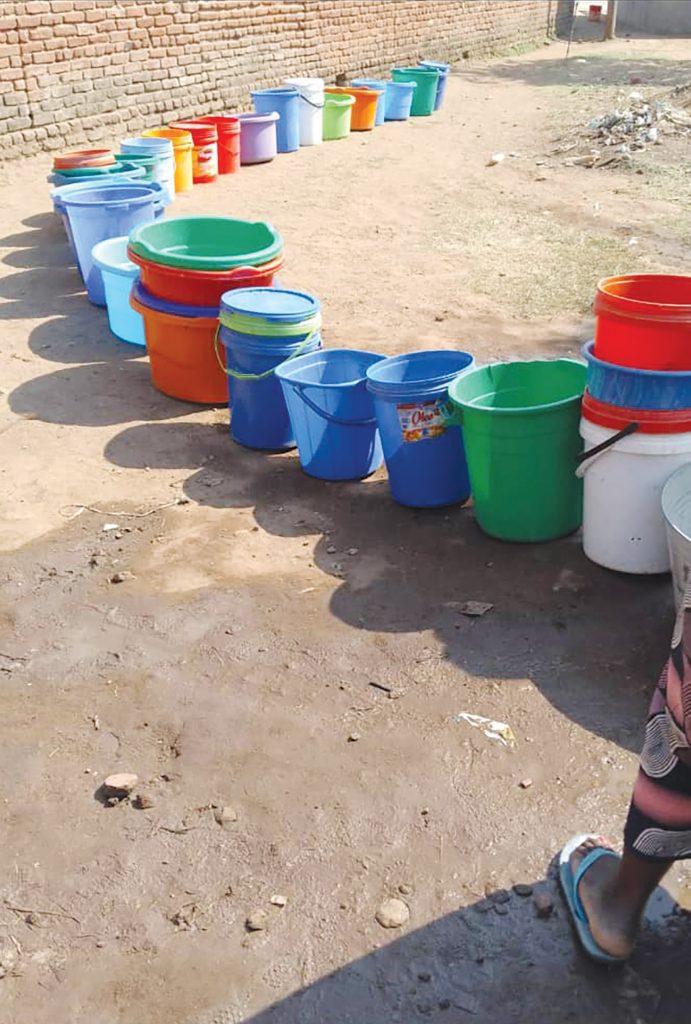
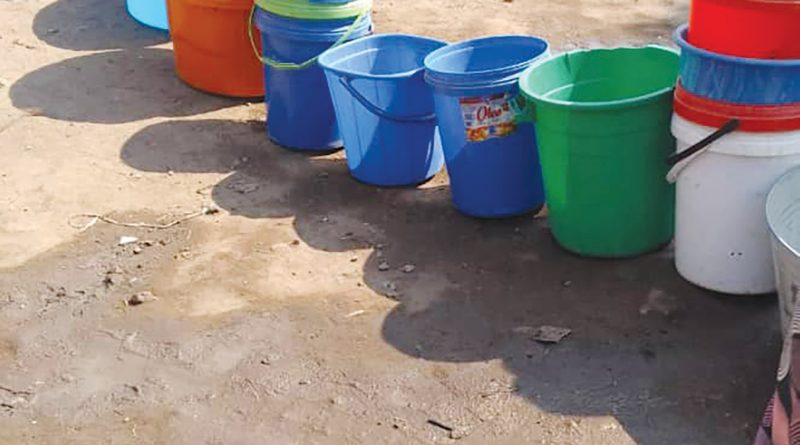
These lines are a common sights at communal boreholes and water taps in Balaka (Photo Credit: Bernadetta Phiso)
For him, all he wants is for the SRWB authorities to transfer all the staff at Balaka office because they have let the district down.
Just like Banda, Gladys Makunganya is another wailing soul whose solace is in the borehole they drilled some years ago. However, the water from the borehole too is not good for usage.
“We can’t use it for washing white clothes, drinking and even cooking. Once we use it for cooking, the food becomes yellowish and loses its taste. For drinking water, we also just rely on the water from shops where on a month we spend around K100,000 for a family of eight,” she said.
With the water crisis currently being experienced in Balaka, the district is sitting on a ticking bomb of an outbreak of cholera and other waterborne diseases. Balaka District Hospital Health Promotion Officer Mercy Nyirenda admitted that the district already has several suspected cholera cases.
“We receive several cases of people showing cholera signs like diarrhea and vomiting which we consider them as suspected cholera cases until confirmed by the laboratory. But in general, diarrheal cases have always been there,” she said.
Way Forward
According to Banda, the water situation worsened of late because there were some technical issues at Mpira Dam. But he said the situation has now normalized and people should expect change in the water supply.
Asked whether they are overwhelmed with the demand, Banda said with the three sources of water which they have, they are able to satisfy the whole Balaka.
“We have three boreholes, of course one broke down but with the remaining two and the water from Mpira we are able to sustain the whole Balaka. People should not despair, we promise better services as we move forward,” Banda said.
However, he said sometimes the water problems is as a result of power outages by Electricity Supply Corporation of Malawi (ESCOM) because once there is blackout, it means the system can’t pump water from the two boreholes.
Acting Chief Executive Officer for SRWB, engineer Tasungana Kapalamula also told Zodiak Broadcasting Station recently that the water crisis is due to the frequent breaking down of pumps, dwindling of water levels from their water sources and low inflow from Mpira dam.
With how the water situation has been in Balaka, it remains to be seen whether the promise by Mr. Banda of ‘better services’ will come to pass. Meanwhile, residents of Lime, Ntonya, Majiga, parts of Andiamo and others can only hope for the day when these ‘better services’ will flow without interruption.