Dangers of extremism: Assessing the 2019 -2020 protests
By Joseph Kayira
Section 38 of the Constitution of the Republic of Malawi guarantees freedom of assembly. It says “Every person shall have the right to assemble and demonstrate with others peacefully and unarmed.” Thus, demonstrations or protests or indeed industrial strikes, have very much become part of everyday life in Malawi since the inception of politics of pluralism or democracy. Significant to the journey of freedom of assembly, are the protests which were led by the Human Rights Defenders Coalition (HRDC) after the 2019 presidential election.
Dissatisfied with the way the presidential election was conducted, which Democratic Progressive Party (DPP) president, Peter Mutharika won, the HRDC and others called on Malawi Electoral Commission (MEC) chairperson, Dr Jane Ansah to resign. The opposition parties, especially the Malawi Congress Party (MCP) and the UTM Party, joined the bandwagon of those who were demanding the resignation of Dr Ansah. She did not budge. President Mutharika too refused to fire her.
Later, in its ruling, the Supreme Court Appeal found Dr Ansah and her commissioners incompetent, citing massive irregularities including the use of correctional fluid. The Supreme Court of Appeal also upheld a Constitutional Court ruling that nullified the 2019 presidential elections in which President Peter Mutharika won a second term.
What followed were nationwide protests which on a number of occasions got violent. In Lilongwe, where the momentum for the protests to have the MEC chair removed were sustained for months posing a threat to private businesses and public infrastructure. Youths – and thugs descended on businesses, looting property, undressing women and literally beating up whoever they suspected to be against their cause.
Such extremism was not checked; if it was those who perpetrated the violence were treated with kid gloves. The organizers of the protests denied any involvement. They said what happened after the demonstrations was not their responsibility. It was the duty of the police to protect people and property, they said. But at the time, the police too were under threat; they were being attacked because they were perceived to be on the side of the leadership or government of the day.
The terror that thugs masquerading as protesters left in their wake, led to some struggling small businesses to close shop. There were violent clashes between protesters and shop owners as the latter tried to protect and defend their businesses due to what had become a criminal tendency by protesters to loot and destroy property.
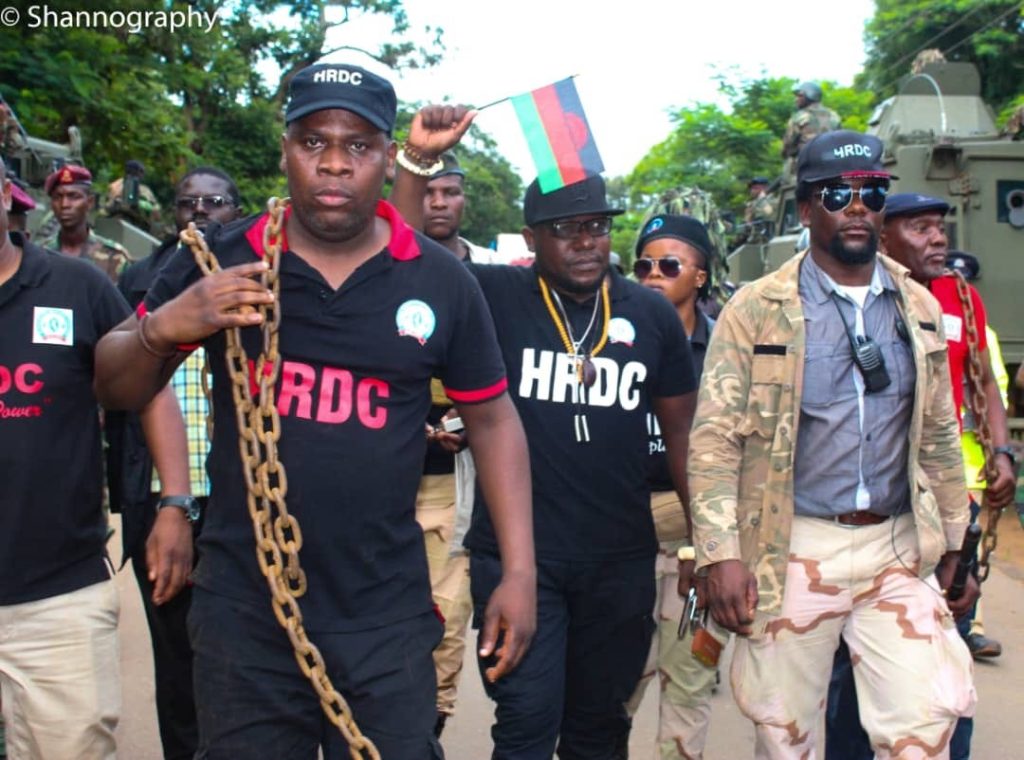
HRDC officials during the 2019-2020 protests (Photo Credit: Internet)
In those days, it became fashionable to be associated with the protesters; those who were for the protests influenced public discourse and appeared to be in the know. They were seen to be fighting for the change that was good for the whole nation. Therefore, those who were against the demonstrations were not democratic; they had actually stolen the election, it was alleged. So, what good would have come from such people? They were vilified everywhere as bad people. But were the attacks on the DPP and its sympathizers justified? Should every cause begin and end with acts of extremism as we saw at the time?
As some have argued, democracy can be expensive. First of all, demonstrations are indeed guaranteed in our statutes. Citizens therefore, have the right to demonstrate peacefully. In the 2019 protests what lacked was peace. When protesters start to build barricades and burn vehicles it turns into something else; it amounts to extremism – it becomes an act of terror. While organizers of the 2019 protests had a known agenda – which was to ask Dr Ansah to resign as MEC chair, some of the people who joined the cause, had their own agenda. They were looters and anarchists.
Organizers of any future protests should work hand in hand with law enforcers to make sure that thugs are not part of the exercise. From the 2019 protests we learn that organization is key if people are to demonstrate with civility. Protests should not breed violence, turn the country upside down or degenerate into civil strife. Governance stakeholders who feel those in authority are derailing in their duties, ought to follow the right path as they seek answers and appropriate action. Sadly, violent demonstrations are seen as a quick fix to economic hardships, bad politics and injustice. Peaceful demonstrations are just one of the many ways the aggrieved can seek redress.
The 2019 protests were a watershed in many ways. They proved that constitutionalism is very much alive in this country. People are free to demonstrate and speak out their views on an issue – and hold those in power to account for their actions. However, in the same vein, we note that sometimes those who hold demonstrations tend to abuse their right to do so. The protests are not always peaceful as the law stipulates. Slowly, extremism is deepening and those with different problems – be they economic or otherwise – rush to the streets to vent their anger on innocent people. It is the reason we must fight extremism, terror and any form of violence.