Democracy without the youth in Malawi?
By Joseph Kayira
Political parties in Malawi have not hidden the fact that they value youth involvement in politics. In fact, all major political parties have structures that clearly give the youth representation in the party hierarchy through youth wings. These youth wings are known by different names. Parties such as Malawi Congress Party (MCP), Democratic Progressive Party (DPP), United Democratic Front (UDF), and People’s Party (PP), maintain active youth wings.
The idea of youth wings is fundamental to party development, progress and grooming. Some of the youth wings include the Youth Cadets (DPP), Young Democrats (UDF), Orange Partners (PP), and in those days Youth League (MCP). The idea of youth wings is not only progressive, it also offers the youth in these political parties to be part and parcel of the decision-making processes.
While those that hold senior positions in political parties are enjoying life in the 60s and beyond, youths are encouraged not to give up and let the old guard remain on the driving seat. Youths can no longer stay idle and wait ‘forever’.
Malawians cannot talk about democracy and good governance without involvement of the youth. The involvement of youths in party structures strengthen democracy, representation and inclusivity. Youths come into the picture of democracy and good governance with innovative perspective, bringing in social progress. Today, youths are more concerned about policies with outcomes that are aligned with their ambitions and needs. If political parties will continue to follow a trajectory that deliberately sidelines the youth – the future of democracy will be hazy. And how can leaders claim legitimacy without the youth in the picture?
For years, youths have been treated as second class citizens when it comes to political governance issues. How do you expect them to excel once they show interest to join politics? Until recently, political parties have only managed to involve youths in politics for wrong reasons. Youths have been involved in politics to perpetrate ‘political’ violence.
It is not by mistake that youths end up as perpetrators of violence. Most youths are vulnerable because they literally have nothing to do. Economically, they are dependent on their parents or guardians; these youths sit idle all day long, waiting for a good Samaritan to bail them out of their poverty.
So, when a politician, dangles a K2,000 note and offers them “a small job to beat political opponents who are giving him or her undue political pressure.” Youths who are just sitting idle jump on such ‘opportunities’ because these ‘opportunities’ are a source of income.
‘Goodies’ will not just end with the K2,000. Beers flow after the work is done. Not much is done by authorities to bring to book the perpetrators of violence. It is even worse when these youths are associated with the party in power. No one wants to burn their fingers. Eventually, those behind these cowardly acts go scot free.
What is more worrisome is the creation of a generation that thinks every political or economic problem is answered through violence. Recipe for political disaster begins with youths who think that by wielding panga knives as they face political opponents means power. This is crime. By 1993, we had agreed in this country that we should embrace democracy and politics of pluralism. It means everyone has the right to freedom of association and freedom to form associations. In simple terms, we all cannot belong to a single political party. By extension, we are saying that we believe in diversity.
Youths must begin to question the motive behind leaders who send them on dangerous escapades to carry out daring crimes. We have seen young men who were involved in crime being cornered by police and spend years in jail. The youth are left to face the long arm of the law on their own. Their political masters simply melt when the heat becomes too much.
Democracy cannot function sustainably or effectively without the youth, as they are crucial for renewing leadership, challenging outdated structures, and maintaining long-term democratic stability. While democracy can technically exist as a system without them, a lack of youth engagement leads to apathy, reduced legitimacy, and a “democratic deficit”.
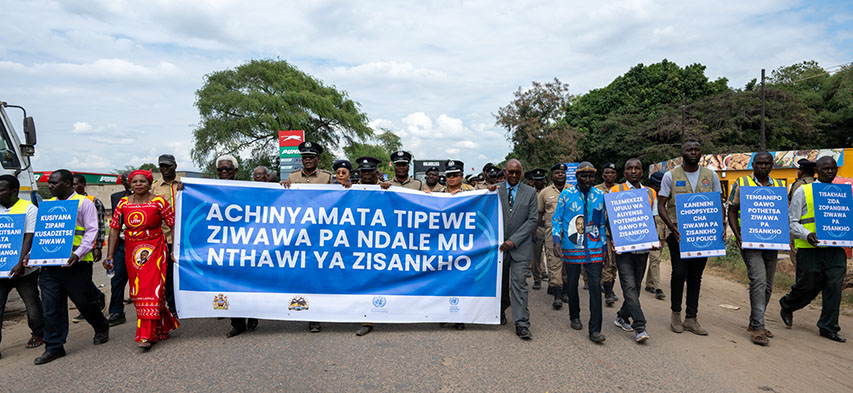
Condemning violence ahead of the September 16, 2025 election (Photo Credit: UNDP)
Zimbabwean Rumbidzai Trish Chitsa, says democracy cannot stand without the youth. She says democracy is about the people, and about governance that responds to the desires of the people.
“Democracy is about the people, and about governance that responds to the desires of the people. I still believe that young people have a shot at unleashing democracy and making it a reality for all, only if we start making incremental steps towards this change.
Will this happen? Yes! Our only question should be how? But I know that when young people with one purpose of bringing about this democracy arise it will be possible,” Chitsa says.
According to the Committee of Ministers of the Council of Europe, young people must begin to engage in democratic processes, decision making and community rebuilding at local and regional levels, through safe, inclusive, and accessible formats.
It says the participation of young people is a determining factor for a sustainable democratic future of Europe. Youth participation means that young people have the right, the means, the space, the structures, the opportunities, the tools and the necessary support to participate in and influence decision making at local and regional levels.
Safeguarding democratic values and fostering civic trust begins with defenders of democracy, who should include the youth themselves. While consolidation of democracy is a must for countries like Malawi, critical to its entrenchment is assurance that youths shall be part of the whole governance process.