Inspiring story of Mangochi’s last standing girl in class
By Bishop Witmos
This year, Duwana Muhammad walked into the Primary School Leaving Certificate of Education (PSLCE) examination hall at Mangale Primary school in Mangochi and sat alone.
She was the only girl who stayed to the end, amongst many female classmates who registered for the Standard 8 national exam without making it to the end.
At 8 am sharp on Monday Morning, 7 boys filled the rows around Duwana’s and the English examination began while the desks that should have held her female classmates remained empty.
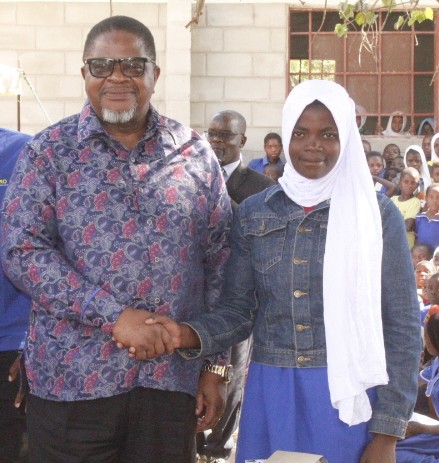
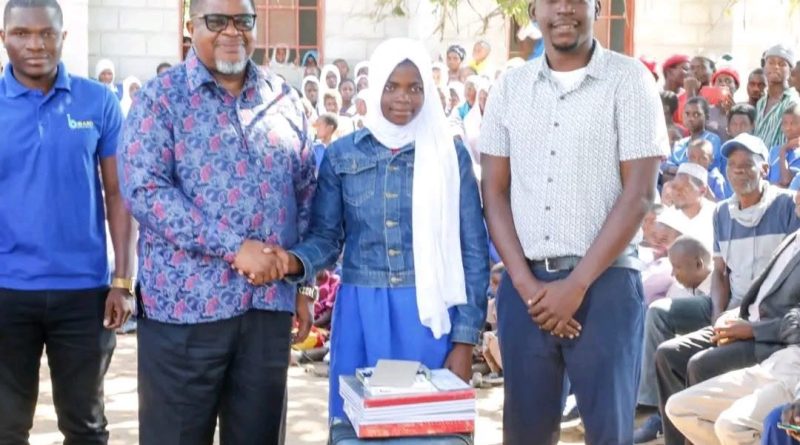
Msaka shakes hands with Duwana in appreciation for her resilience (Photo Credit: Bishop Witmos)
As the invigilator closed the examination room door, Duwana sat frozen at her desk, her heart pounding in the silence and she felt the cold weight of loneliness.
One by one, her female classmates had dropped out before the PSLCE – some due to early marriage; others because their families could not afford examination fee; while a few due to pregnancy.
‘‘I was terrified, with the room filled with boys who comfortably whispered and shifted chairs to make themselves comfortable,” said Duwana.
“That moment reminded me why I had stayed -to finish what I had started with my female classmates to prove that a girl could still be there when the door closes,’’ explained Duwana in an interview with Malawi New Agency (Mana).
To reach the examination day Duwana had to balance schoolwork with household chores, and fending off boys who came with marriage proposals.
The 16-year-old girl, who studied by paraffin lamp after fetching water and firewood each evening, hails from Traditional Authority (T/A) Chowe, and she is the third born in a family of 7 children.
According to Mangale Primary Head Teacher, Boniface Gomiwa, 28 girls started Standard 8 at the school but the rest fell by the wayside and only Duwana remained.
‘‘Many girls fail along the way due to early marriages, long distance to school, and financial stability at home,’’ Gomiwa told Mana.
Duwana’s story has drawn national attention on social and mainstream media, sparking debate over girl child education and the need to empower girls to motivate each other.
Moved by her resilience, Maranatha Academy Managing Director, Ernest Kaonga, has offered her a full scholarship if she passes the exams.
‘‘Against all odds, Duwana Muhammad stood firm as the only girl sitting for the standard 8 exams, shattering years-long cycle of regional dropouts. Such fierce brilliance could never go unnoticed,’’ Kaonga posted on his Facebook page.
A region-wide challenge
At Mangale, the number of learners in lower classes is higher, and thins out in upper classes. This year’s school calendar shows 378 in Standard 1, 197 in Standard 3, and 31 in Standard 7. Only 8 pupils sat this year’s PSLCE exams.
In Mangochi, 376,130 pupils enrolled in primary school in 2025. That year, 11,508 boys and 11,494 girls dropped out, while in 2024, out of 352,697 pupils, 17,541 boys and 17,037 girls dropped out.
Ironically, dropout rates for both boys and girls are similar. Mangochi District Education Office recorded 10 percent for boys, 9 percent for girls in 2024; and 6 percent for both boys and girls in 2025.
According to the latest Malawi Education Statistics, in 2024, a total of 227,102, primary school learners (1112,311 boys and 114,791 girls) dropped out of school, representing 4.3 percent dropout rate of primary school learners countrywide.
Government targeted to reduce dropout from 13.35 percent to 11 percent by 2025; then 8 percent by 2030.
Statistics indicate districts such as Chiradzulu, Lilongwe, Rumphi north, Karonga and Mangochi as having high dropout rate, with main drivers including lack of support, early pregnancies and child marriage.
Ministry of Education also lists Mangochi as a lakeshore district with high dropout due to poverty as kids join fish businesses.
Senior Chief Chowe says financial pressure still haunts girls in his area most.
‘‘Whenever families face financial burdens on school fees, they choose to educate a boy child and leave out the girl child. This tendency is very bad,’’ explained Chowe.
Survivors and solutions
Some women have beaten the odds. Mangochi Nkungulu Member of Parliament Aisha Adams grew up crossing rivers before sunrise to reach class.
‘‘As a woman born and raised here, I know what it means to walk long distances for education. Unlike boys, girls are given household chores after school, a tendency that deny them an opportunity to learn,’’ said Adams.
Despite the high dropout rate in the district, the council has made strides in ensuring that education is accessible to all in the district.
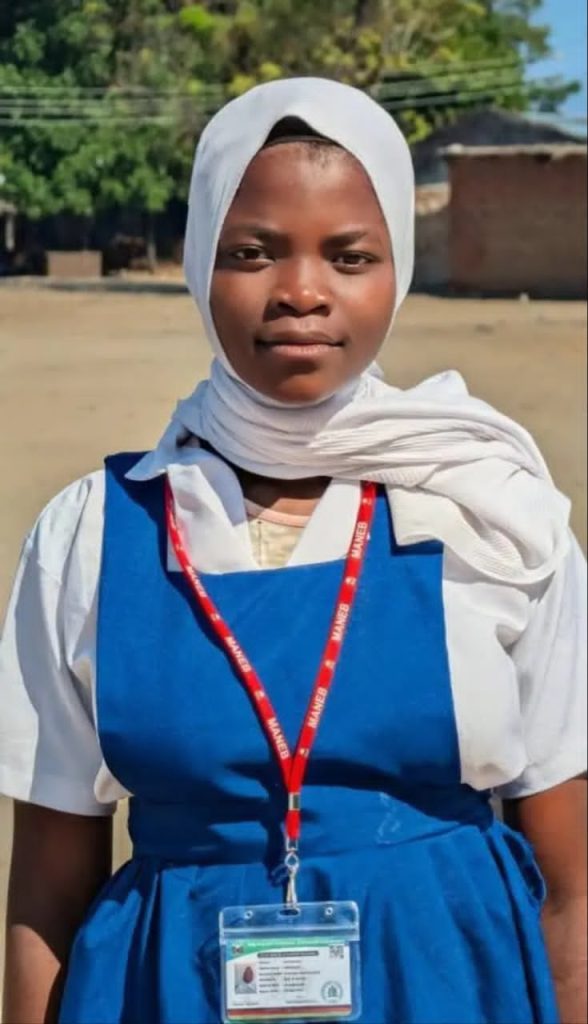
Duwana patiently awaits examination results (Photo Credit: Bishop Witmos)
The Mangochi Nkungulu legislator worked with the district council to build a 50-capacity girl’s hostel at Changali CDSS using the Constituency Development Fund (CDF).
The K43 million hostel has a kitchen, toilets, and bathing rooms.
To tackle infrastructure gaps, Mangochi District Council is using Constituency Development Fund, District Development Fund (DDF), as well as Governance to Enable Service Delivery (GESD), to build school blocks, administration blocks, labs, libraries, and teachers houses across the district.
The schools include Katole, Ngapani, Mangale, Changali, Nkotatoka, Nangapite and many other Community Day Secondary School.
On the other hand, Primary schools like Thundu, Nangwazi, Ruwi, and Chilawi have also received classrooms and toilets.
Under a climate resilience project, a K435 Million girls hostel and matron’s house are under construction at Chilipa CDSS.
Yet challenges remain: Mangochi now has 2,588 primary classrooms, up from 2,401 in 2024.
Due to population growth, the pupil-to classroom ratio rises from 147:1 to 151:1, while pupil-to-teacher ratio also worsens from 82:1 to 85:1, with teachers increasing from 4,323 to 4,614.
Hope in policy change
Access to education is central to Malawi vision 2063. But after primary school, many learners face secondary school fees as a stumbling block.
In his 2025 campaign, President Arthur Peter Mutharika promised free secondary education in public secondary schools. Three months after taking office, in his State of the Nation Address (SONA) in February this year, he confirmed it had started.
‘‘Last year, I announced that secondary education in public schools will be free, except for boarding. There were many doubting Thomases. Today I can confirm that free secondary education has begun.’’
‘‘This means that financial burden on several parents has been lifted, and over 1,800 students who dropped out of school on financial grounds have already returned to school,’’ said Mutharika in his SONA.
The President added that his Government will continue to invest in higher education institutions, saying that in the 2026/27 Financial Year, Government will allocate adequate financial resources for Mombera University, whose construction had stalled.
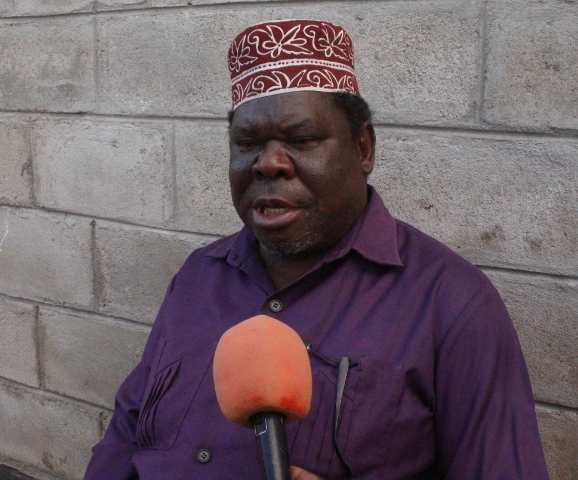
High school dropout in the area worries Senior Chief Chowe (Photo Credit: Bishop Witmos)
Mutharika said that Government will also continue providing loans to support students who cannot afford university education, adding that he will raise the number of beneficiaries from 32,480 to 38,000.
‘‘I do what I promise, and I do not promise what I cannot do,’’ the President said.
Few months later, the Higher Education Students Loans and Grants Board (HESLGB) in Malawi announced that, for the 2025/2026 loan cycle, it had increased the number of learners who access loans from the board from 32,000 to 38,000.
For the first time, the beneficiaries include those under the Open and Distance e-learning students.
Following Duwana’s amazing story, Minister of Education Bright Msaka visited Mangochi, to appreciate efforts made in promoting education.
Msaka toured Mangale school and, to encourage learners at the school to work extra hard, he sat where Duwana had sat when she wrote her exams that cold week.
‘‘The demography of Mangale schools indicates that more than 50 percent of children in the area are not going to school. This is the situation across and as a ministry we will ensure that every child has access to education without exception,” the minister said.
‘‘As government, we are working tirelessly in providing frameworks for every child to have access to quality basic education, through infrastructure development, and that no one drops out due to school fees,’’ the minister added.
Months after the declaration, Mangochi District Council has started registering more enrolments in primary schools.
‘‘Most pupils in the district have turned back to school this year, as our office registered 202,619 pupils, as compared to 196,128 last year. We are yet to register a student seeking secondary bursary support,’’ said Mangochi Social Welfare bursary coordinator, Hurvey Mbwezo. Meanwhile, Duwana keeps her fingers crossed as she, together with over 250,000 pupils, patiently wait for MANEB to release the PSLCE results, and for her door to Maranatha to open. – Malawi News Agency.